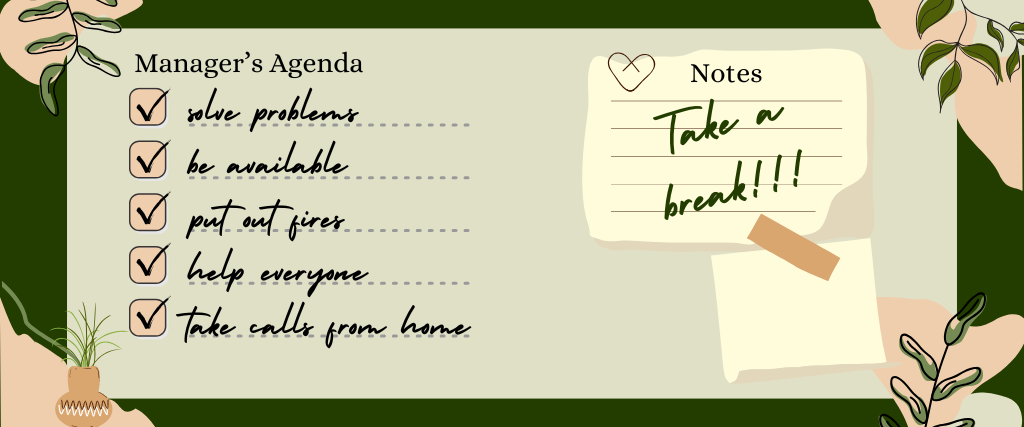
You’re the manager. You don’t get a lunch break.
If you’re a manager, you’ve heard–or at least felt–this before.
It’s not that we don’t get a lunch break, we do. In fact, we generally get to choose when we take it and whether or not we leave the office to ensure those precious 30 minutes aren’t interrupted. So what’s the problem? I’m sure we’re all on the same page here–they are! Ok, well…maybe we are, too.
If we’re going with “they are” then lets get our passive aggressive thoughts out in the open right away. The people we manage do not see us as human beings. We are where problems land, frustrations spill over, and blame too often follows. We save their asses only to get the cold shoulder for holding them accountable. We are the source of all their problems, and also “I know you’re eating lunch but can you help me?”
And we will say yes. That is because every manager I’ve ever met would move a mountain for their team. We didn’t become managers because we hate people and want to watch them suffer. We’re here because we love people. We love solving problems and we want to help! We know the members of the team are the only reason the team succeeds.
When we’re at our best, we know they don’t mean to treat us like a 24 hour convenience store. They don’t realize that they walked in to ask for help just a minute after we got off the phone with a highly emotional client. They don’t know our snippy response is because we haven’t had time to process that conversation before moving on to their problem. And it’s not their fault. We are expected to show up for them at any given moment, no matter what is going on with us.
It’s a lot. Too much, sometimes. And if sometimes becomes most of the time, that’s burnout.
So let’s talk about us. Where is our responsibility in all of this?
- Be Direct: If you’re on your lunch break, be on your lunch break. Ask if the situation can wait 20 minutes. Better yet, leave the building! Being unavailable is the fastest way to help the team realize you are not always available. These small lunch break lessons later translate to bigger ones. Imagine taking a vacation and not receiving one text or phone call from work. Seems to good to be true? Trust me, it’s not.
- State Your Needs: There will be times when you are mentally unable to process the needs of another person. This is completely normal and does not signal weakness or failure. If you need a minute to process or cool down, say it. If you have an office, close the door and place a “mental health break” note outside. If someone approaches you, gently let them know you’ll get back to them in a few minutes. After all, they can’t read your mind and may have no idea you’re going through something. A little vulnerability helps your team understand that you’re human and that you don’t have unlimited resources.
- Be Consistent: No matter what is going on with you, it is not their fault. You can be in a bad mood, or need time to self-regulate, but you cannot take it out on your team. Swinging from temperamental extremes will cost you the trust of your team and you may never fully get it back. They have a right to expect an emotionally consistent manager they can rely on.
- Teach, Don’t Solve: Managers can solve a problem like nobody’s business. It’s what we live for. Sometimes we forget to stop and ask, “Is this my problem?” If it’s not, whose problem is it? Why isn’t that person solving their own problem? Do they know how to solve it? Do they even know it’s their responsibility? And, shocker, the more often they are taught to solve their own problems, the less they will interrupt you at lunch.
- Check In with Yourself: We all know being a manager is tough. It’s a role that naturally comes with heavy scrutiny and emotional weight. That’s why it’s essential to pause and check in with yourself regularly to protect your well-being. Ask yourself where your frustrations are coming from and what you can do differently to change them.
It can feel scary to face the roadblocks we place in our own way, but meeting that fear head-on is often the quickest path to greater happiness. Boundaries are hard to set because we worry about alienating our team. The truth is, when you’re willing to show a little vulnerability and remind them that you’re human, it becomes easier to give yourself permission to be human too.